
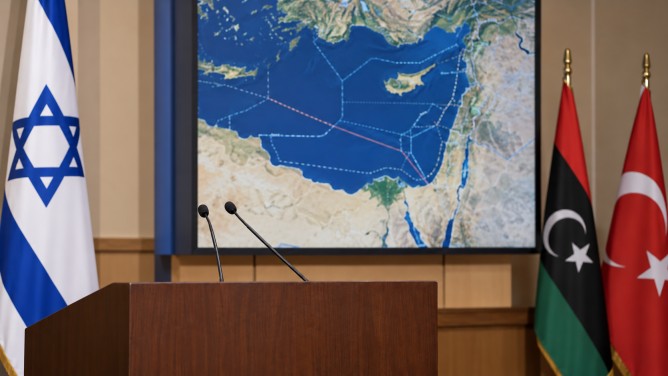
Israel has expressed strong opposition to a maritime agreement ratified by eastern Libya’s parliament with Türkiye, citing concerns that the deal could jeopardize the maritime rights of regional allies Greece and Cyprus. The agreement delineates boundaries in the resource-rich eastern Mediterranean, an area significant for its potential natural gas reserves.
The maritime deal has been a point of contention, with Greece, Cyprus, and Egypt contesting its legitimacy, arguing that it encroaches on their territorial claims. The European Union has also questioned the legal standing of the agreement, stressing the importance of upholding the sovereign rights of its member states under international law.
Israel’s Foreign Ministry criticized Türkiye for fostering instability in the region, underscoring its strategic ties with Greece and Cyprus. Diplomatic relations between Israel and Türkiye have been strained in recent years, exacerbated by differing stances on the Gaza conflict.
In defense, Türkiye has maintained that the agreement aligns with international law and serves the interests of both Türkiye and Libya. Turkish Foreign Minister Hakan Fidan remarked that the Libyan parliament’s ratification merely formalizes an arrangement Türkiye already regarded as active.
The controversy also highlights the ongoing political division within Libya. The eastern region, under military leader Khalifa Haftar, continues to operate in opposition to the internationally recognized government in Tripoli, despite developing ties with Ankara.
The European Union has reiterated its call for adherence to international maritime law and the protection of its member states’ sovereign rights. Greece has escalated the issue to the United Nations, warning that the agreement could have broader implications for security and stability in the eastern Mediterranean.