
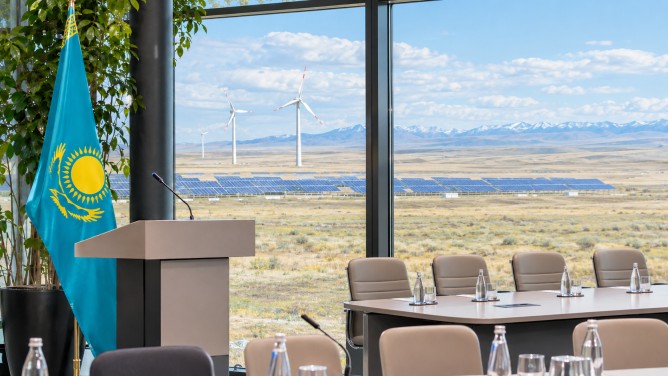
Kazakhstan has secured approximately $1.2 billion in agreements at the COP31 climate summit in Antalya, Türkiye, aimed at bolstering its renewable energy projects and advancing its transition to a low-carbon economy. The nation is set to develop significant wind farm projects, including a 150-megawatt facility in the Turkistan Region and a 1-gigawatt installation in the Kostanai Region.
Among the key initiatives is the Aqyl Energy project, which plans to deploy 1.35 million smart gas meters across Kazakhstan to enhance monitoring and improve energy efficiency. Additional efforts focus on reducing methane emissions from gas distribution networks and restoring degraded land in the Almaty Region, contributing to Kazakhstan’s emissions reduction targets through international cooperation.
Kazakhstan is enhancing its climate investment strategy via the Country Climate Investment Platform. This platform aims to connect government bodies, international financial organizations, and private investors with priority environmental projects. Another major initiative, the Qazaqstan Just Energy Transition investment platform (QaJET), seeks to mobilize around $20 billion to develop at least 10 gigawatts of renewable energy capacity by 2035, which includes electricity grid modernization and energy storage projects.
The country has set ambitious goals to reduce greenhouse gas emissions by 17% below 1990 levels by 2035, with a conditional target of 25% dependent on international support, and aims to achieve carbon neutrality by 2060. Kazakhstan’s commitment extends to water security and environmental protection in Central Asia, addressing the pressures of climate change on regional water resources, agriculture, and ecosystems.
Kazakhstan’s latest climate report highlights that net greenhouse gas emissions were 10.06% below 1990 levels in 2024. The nation plans to enhance environmental monitoring, expand renewable energy investment, and attract international financial and technological support to meet its climate goals.